Many of the events in the Lord-Lieutenant’s diary reflect the priorities of HM The King and the Prince and Princess of Wales.
The King’s concern for the environment and climate change is long-standing, seen most recently in his address at the opening of COP28 in Dubai.
The Earthshot Prize, launched by the Royal Foundation of the Prince and Princess of Wales, is helping a wide range of individuals and teams to develop inspiring solutions that will have a positive effect on environmental change and improve living standards globally, particularly for communities most at risk from climate change.
It can be difficult for us as individuals to know what we can do to help the environment and reduce the rate of climate change, but this is something that the Essex Climate Action Commission has been set up to help with.
Its chair, Professor Jules Pretty DL, Director of the Centre for Public and Policy Engagement at the University of Essex, stresses that in the face of global problems our local behaviour can have a real effect.
The Impact of Climate Change
Professor Pretty writes that world economies and cultures face a series of unprecedented and interlocking crises on climate destabilisation, nature loss and social inequality.
These have already left countries and ecosystems economically vulnerable, with many increasingly unable to deliver the support and services necessary for basic livelihoods for all their citizens.
Since the pre-industrial period, the average planet temperature has risen by +1.2°C. International and national processes have created roadmaps designed to ‘keep 1.5 alive’ – to limit planetary heating to less than +1.5°C, and at worst +2°C.
This is looking like a challenge to achieve.
Dramatic and sudden collapses are feared. Increases in pollution can lead to fast transformations once critical thresholds are passed.
There are eight concerns:
– loss of Arctic summer ice
– loss of West Antarctic sea ice
– high intensity El Ninos
– loss of stability of Amazon rainforest
– melting of the Greenland icesheet
– dilution of the Gulf Stream
– disruption of the Indian monsoon
– loss of high mountain glaciers.
Recognition of these problems is increasingly widespread. Net Zero emissions by 2050 is a target now set by 149 countries, and by 8000 businesses, cities, regions and investors across the world.
In the UK, more than 20 sub-national public authorities in counties and cities have also set net zero targets, including Essex.
A reduction in carbon dioxide emissions from 55 billion tonnes per year to zero by 2050 would set the world on a path towards safety. Three successive 50% cuts over three decades would almost achieve this: a cut of a half during the remaining 2020s, a further half by 2040, and another half by 2050. These would reduce total emissions to 12.5% of current levels, close to enough if there was also some carbon capture and sequestration.
A safe place for humanity, says Professor Pretty, would be one tonne of carbon emissions per person, amounting to about 8–10 billion tonnes for the whole world.
In the UK, our emissions are 7.7 tonnes per person per year. We must get to one tonne each, and here’s how…

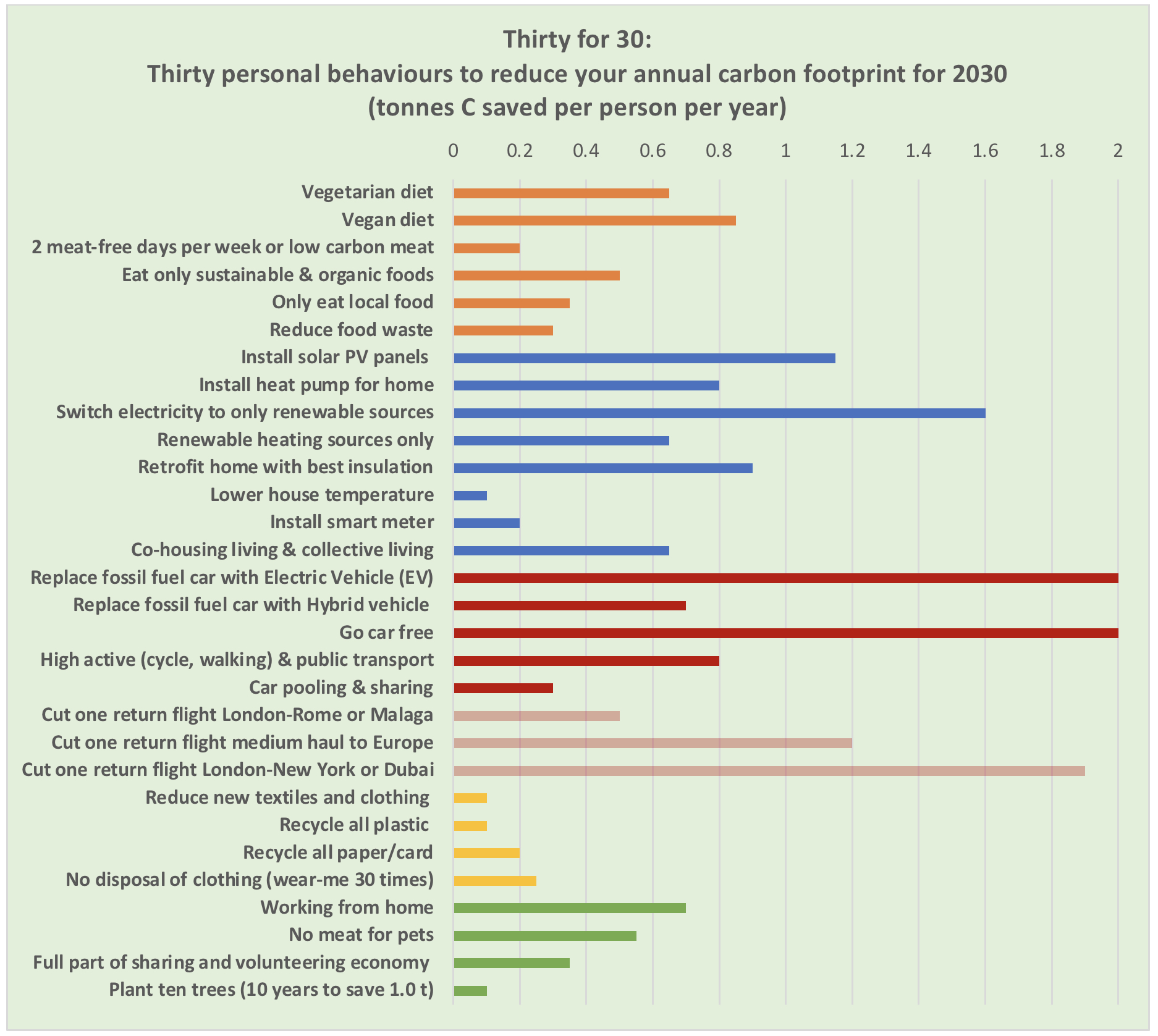
Thirty for 30
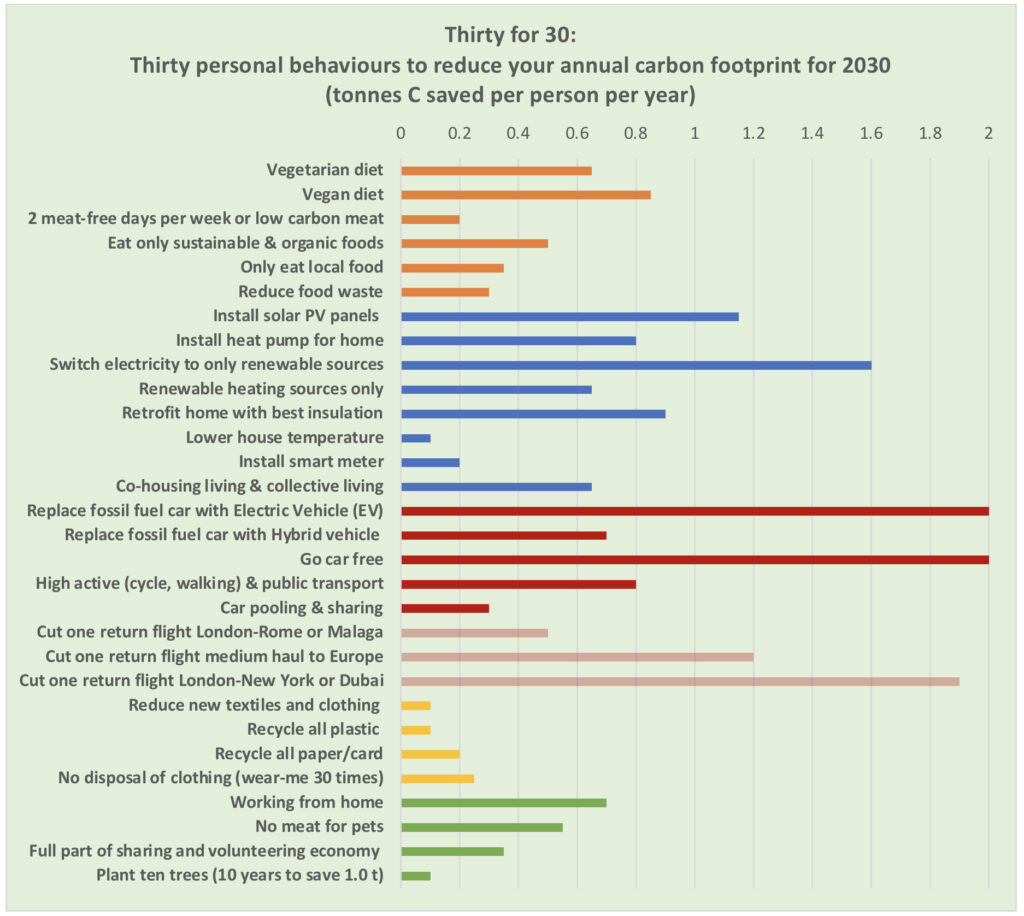
Professor Pretty’s chart ‘Thirty for 30’ sets out how to cut carbon in five domains (food, home, mobility, stuff, leisure) by 2030.
The guidance is this: don’t try to do too much at once.
Pick one choice, he suggests, and see if you can go with it; and then next year pick another. The priority is this decade of the 2020s, and there are thirty options for cutting your carbon by 2030.
There is much that governments are doing around the world: starting to leave fossil fuels in the ground, cutting emissions, incentivising the switch to renewable energy and technologies, electrifying everything, retrofitting buildings, helping business innovation, and investing in green growth.
The great thing is that early action saves costs for households and helps us all as we make the shifts towards a world without fossil fuels.
Several initiatives are being progressed by communities across the county.
Among these, for example, is one to de-carbonise the primary school in Tollesbury. First reported by the BBC in April 2023 the project has since raised £250,000 from residents, enabling it to access a grant for £400,000 from the government. Work is under way and the pupils at the school are enthusiastic champions for the positive outcomes that are predicted.
The Lord-Lieutenant acknowledges the outstanding environmental work being done by organisations, businesses, and communities across the county.
She welcomes hearing news and learning information about climate change initiatives in Essex and looks forward to learning more during her visits in the coming months.